
Can you collect your parents’ Social Security when they die? The short answer is yes, but there are specific rules and conditions.
Understanding these details can help you navigate this complex process. When a parent passes away, their Social Security benefits don’t simply vanish. Instead, certain family members might be eligible to collect survivor benefits. This includes children, widows or widowers, and even dependent parents in some cases.
Knowing who qualifies and what steps to take can make a significant difference. In this post, we will explore the eligibility requirements, application process, and important details you need to know. By the end, you will have a clearer picture of how to handle Social Security benefits after a parent’s death. Let’s dive in!

Credit: www.northwesternmutual.com
Social Security Basics
Social Security provides financial support to individuals during retirement. It also helps families when a loved one passes away. Understanding the basics can help you navigate the system. This guide covers eligibility and types of benefits available.
Eligibility Criteria
Knowing if you are eligible for benefits is crucial. Here are the main criteria:
- Age: You must be 60 or older to collect survivor benefits.
- Marital Status: Surviving spouses and divorced spouses may qualify.
- Length of Marriage: You must have been married for at least nine months.
- Children: Unmarried children under 18 may also qualify.
Types Of Benefits
Social Security offers different types of benefits. Each serves a unique purpose:
- Survivor Benefits: Given to the deceased’s spouse, children, or parents.
- Lump-Sum Death Payment: A one-time payment of $255 to the surviving spouse or children.
- Widow/Widower Benefits: Provides monthly benefits to the surviving spouse.
- Children’s Benefits: Monthly payments to children under 18 or disabled children.
Understanding these benefits can help you make informed decisions. Always check specific eligibility requirements with the Social Security Administration.
Survivor Benefits Overview
When a loved one dies, navigating financial matters is tough. One key support is the Social Security Survivor Benefits. These benefits help families cope with the loss of a breadwinner. Understanding the eligibility and application process is crucial.
Who Qualifies?
Survivor benefits are available to specific family members of the deceased. The following categories typically qualify:
- Widows and Widowers: Spouses aged 60 or older.
- Disabled Widows and Widowers: Spouses aged 50 or older with a disability.
- Surviving Divorced Spouses: If the marriage lasted at least 10 years.
- Children: Unmarried children under 18, or up to 19 if they are full-time students.
- Disabled Children: Any age if they were disabled before 22.
- Dependent Parents: Aged 62 or older who relied on the deceased for at least half of their support.
How To Apply
To apply for survivor benefits, gather necessary documents and follow these steps:
- Contact the Social Security Administration (SSA) by phone or visit a local office.
- Provide the required documents:
- Proof of death (death certificate).
- Social Security number of the deceased.
- Your Social Security number.
- Birth certificates and marriage certificate, if applicable.
- Fill out the application form as directed by the SSA representative.
- Submit the application and supporting documents.
Processing times can vary, so it’s best to apply promptly. Visit the SSA website or call for more details.
Parent’s Social Security
When a parent passes away, their Social Security benefits can provide financial support to surviving family members. Understanding the rules and requirements is crucial. Below, we explore the conditions for collection and the necessary documentation.
Conditions For Collection
To collect your parent’s Social Security benefits, certain conditions must be met:
- Age Requirement: You must be at least 18 years old. Exceptions apply for disabled children.
- Relationship Proof: You need to prove you are the deceased’s child. This can be biological, adopted, or stepchild.
- Dependency: You must have been financially dependent on your parent.
Meeting these conditions ensures eligibility for Social Security benefits.
Required Documentation
Gathering the correct documents is essential for a smooth application process:
| Document | Purpose |
|---|---|
| Death Certificate | Proof of parent’s death |
| Birth Certificate | Proof of relationship |
| Social Security Number | Identity verification |
| Financial Records | Proof of dependency |
Submit these documents to the Social Security Administration. Ensure accuracy to avoid delays.
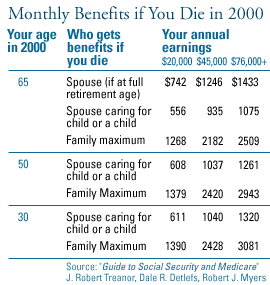
Credit: money.cnn.com
Spousal Benefits
When a parent passes away, understanding spousal benefits under Social Security is crucial. These benefits can provide financial support to surviving spouses. This section will delve into the eligibility criteria and how the benefits are calculated.
Eligibility For Spouses
To qualify for spousal benefits, certain conditions must be met:
- The surviving spouse must be at least 60 years old.
- If the spouse is disabled, the age drops to 50.
- Survivors can receive benefits at any age if they care for a child under 16 or disabled.
- The marriage must have lasted at least nine months before the spouse’s death.
Benefit Calculation
How much a surviving spouse receives depends on various factors:
- The deceased spouse’s earnings record.
- The age of the surviving spouse when benefits start.
Here is a table summarizing the percentage of benefits a surviving spouse can receive:
| Age of Surviving Spouse | Percentage of Deceased Spouse’s Benefit |
|---|---|
| Full Retirement Age | 100% |
| 60 to Full Retirement Age | 71.5% to 99% |
| 50 to 59 (if disabled) | 71.5% |
| Caring for a child under 16 or disabled | 75% |
Important: The benefits reduce if the surviving spouse starts early. Waiting until full retirement age results in higher benefits.
Impact On Your Own Benefits
When a parent passes away, it’s natural to wonder about the impact on your own benefits. Social Security can be complex, and understanding how a parent’s death affects your benefits is crucial. This section will explore how your retirement and disability benefits might change.
Effect On Retirement Benefits
If you are eligible for retirement benefits, your parent’s Social Security does not directly increase your amount. Instead, you might be eligible for survivor benefits. Survivor benefits can provide financial support if your parent was your primary provider. This can be useful if your own retirement benefits are lower.
These benefits can start as early as age 60 or 50 if you are disabled. However, you must choose wisely between survivor benefits and your own retirement benefits. You cannot receive both at the same time. It’s important to calculate which option provides the most long-term support.
Impact On Disability Benefits
Your parent’s death can also influence your disability benefits. If you receive disability benefits, you might qualify for additional support through survivor benefits. This can be beneficial if your own disability benefits are limited.
Keep in mind that eligibility for survivor benefits depends on your parent’s work history and the amount they contributed to Social Security. The Social Security Administration reviews each case individually, so consult with them to understand your specific situation.
In summary, the impact of a parent’s death on your benefits varies. It is essential to understand how these changes can affect your financial planning.
Common Myths
Many people have questions about collecting Social Security after a parent’s death. Unfortunately, there are many common myths surrounding this topic. These myths can lead to confusion and misunderstandings. Let’s break down these myths and reveal the truth.
Myth Vs. Reality
| Myth | Reality |
|---|---|
| You can collect your parents’ full Social Security benefits. | You can only receive survivor benefits, which are a percentage. |
| Only children can collect survivor benefits. | Spouses and dependent parents may also qualify. |
| Survivor benefits start automatically. | You must apply for survivor benefits. |
Frequently Asked Questions
Can I collect both my own and my parent’s Social Security benefits?
No, you cannot collect both. You can only receive one benefit at a time.
How do I apply for survivor benefits?
You need to contact the Social Security Administration. You may apply over the phone or in person.
What documents do I need to apply for survivor benefits?
- Your birth certificate
- Your parent’s death certificate
- Proof of relationship (e.g., marriage certificate)
Is there a time limit to apply for survivor benefits?
Yes, you should apply as soon as possible. Delaying can affect your benefits.
Can dependent parents collect Social Security after their child’s death?
Yes, if they were dependent on the child for financial support. They may qualify for survivor benefits.
Understanding the truth about Social Security benefits is crucial. It can help ensure you get the support you need. Don’t fall for common myths. Always check with the Social Security Administration for accurate information.

Credit: sackettlaw.com
Frequently Asked Questions
Can I Collect My Deceased Parent’s Social Security?
Yes, you may be eligible for survivor benefits. It depends on your age and other factors.
How Do I Apply For Survivor Benefits?
Contact the Social Security Administration. They will guide you through the application process.
What Documents Are Needed For Survivor Benefits?
You need the death certificate, your birth certificate, and your parent’s Social Security number.
Can A Child Receive Survivor Benefits?
Yes, children under 18 can receive benefits. Sometimes, full-time students or disabled children also qualify.
How Much Will I Receive In Survivor Benefits?
The amount varies. It depends on your parent’s work history and earnings. Contact Social Security for details.
Conclusion
Understanding your parents’ Social Security benefits can be challenging. It’s essential to know your options. Seek guidance from Social Security experts. They can provide clarity and help you make informed decisions. Remember, each situation is unique. Being informed ensures you receive the benefits you’re entitled to.
Take the time to explore your options thoroughly. This knowledge can provide peace of mind during difficult times. Always stay updated on Social Security rules. They can change and impact your benefits. Stay proactive and protect your financial future.