A baby’s vision develops gradually after birth, allowing them to perceive their surroundings and connect with loved ones. Newborns’ sight is quite limited, but it progresses rapidly in the first few weeks and months. Understanding when babies start to see, including their ability to recognize faces and hear sounds, can help parents support their child’s sensory development. In this article, we explore the fascinating timeline of baby vision development week by week and answer common questions like “When do babies start seeing clearly?” and “When do babies start seeing color?”
When Do Babies Start to See? Understanding Baby Vision Development
Babies’ growth, including their vision, happens gradually and at varying rates. Some babies take longer to develop their sight, while others start seeing sooner. But when exactly do babies start to see? Typically, babies begin to develop their vision within the first two weeks after birth. However, the timeline can vary from one baby to another.
What Is the Typical Timeline for Baby Vision?
Most newborns start to perceive their surroundings within a week of birth. Initially, they can only detect shapes, shadows, and light at a distance of 8–10 inches. Over time, their ability to see colors and focus on objects improves.
Curious for more insights? Keep reading to uncover why vision development differs for each baby and how their eyesight progresses over time.
The Vision Ability of a Newborn
At birth, a baby’s eyesight is limited and underdeveloped. Their vision is roughly 20/400, which means their world is blurry, and they can only focus for a few seconds at a time. According to Dr. Kate Land, MD, a pediatrician with The Permanente Medical Group, it can take three to five years for a baby’s vision to fully mature.
For the first few months, babies experience a blurry view of the world, with short bursts of gazing. Despite this, it is crucial for newborns to engage in regular visual practice to help develop their eyesight.
While their vision is not fully functional at birth, the journey of sight is a fascinating process that unfolds as they grow. Stay tuned for more details on how your baby’s eyesight progresses and what you can do to support their visual development.
Kazlas cites the saying that “in case a baby does not utilize their vision, they will definitely lose their vision,” to put more emphasis on the importance of a good visual experience during the early stages of development. Hence, the nature and level of practice at the early stages are part of the answer to the question, when do babies start to see?
When Do Babies Start Seeing and Hearing?

From birth, babies have a basic ability to detect light and motion, but their vision and hearing are far from fully developed. Their visual acuity is limited, making it difficult for them to discern fine details. However, during the first few weeks of life, their sensory perception improves rapidly. By the end of the first month, babies begin to see more clearly and can recognize familiar faces and voices. This early ability to connect faces with voices plays a crucial role in bonding and emotional development.
What Does a 2-Week-Old Baby See?
At just two weeks old, a baby’s vision is still blurry but functional enough to focus on objects within a range of 8–12 inches. This proximity is ideal for them to gaze at their caregiver’s face during feedings, fostering early interactions. While they cannot yet distinguish intricate details, high-contrast patterns, such as black-and-white shapes, and bold colors tend to grab their attention. This limited focus helps them prioritize nearby faces, laying the foundation for social and visual engagement.
What Can Babies See At 4 Weeks?
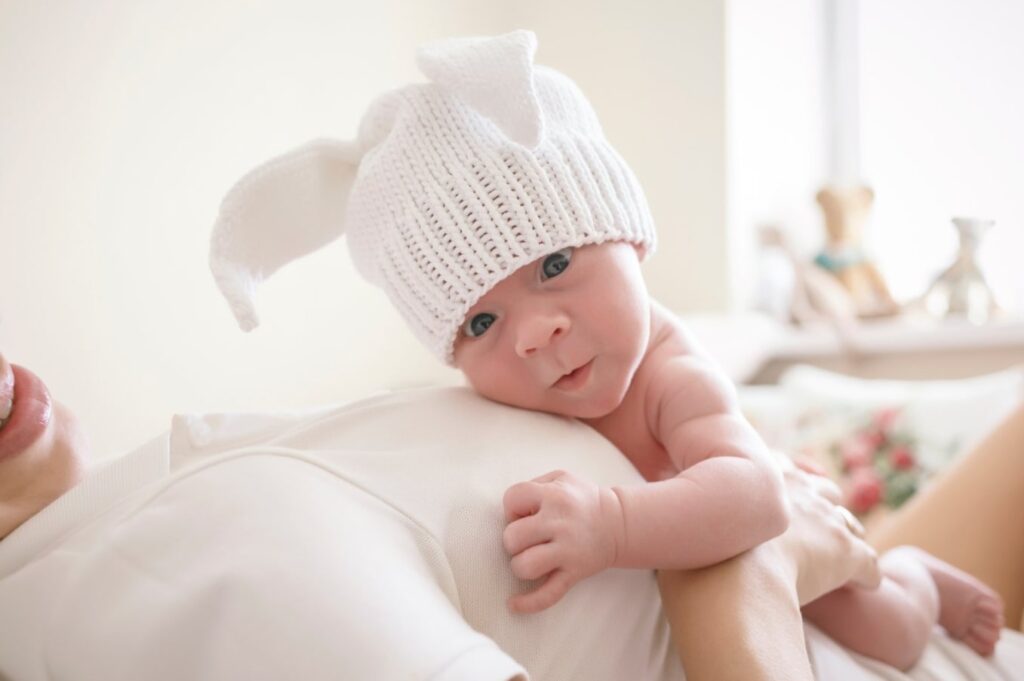
4 weeks is just a month after delivery and the baby’s sight is still developing. By this time, babies can see any object within a radius of 18 inches. If you want to entertain the baby with toys at this early age, place them 18 inches in front of the baby.
You will also notice that the baby will start following objects around the room within the same radius. Try to measure the development milestone with a bright-colored toy or even your hand. The baby will follow its movements as you move from one direction to the other.
How Far Can Babies See at 1 Month?
By the time they are one month old, babies’ visual range remains relatively close, around 12 inches. However, their focus becomes sharper, allowing them to track moving objects with their eyes more consistently. At this stage, babies may show a strong preference for observing faces and shapes, spending more time staring at their caregivers or visually interesting objects. This early tracking skill indicates a developing coordination between their eyes and brain.
How far can babies see at 6 weeks?

The length of vision improves slightly above 18 inches at six weeks. You will not only be wondering, when do babies start to see? at this stage but also notice new behavior. The baby will try to reach for the objects they can see. For instance, the baby may touch the mother’s face when breastfeeding. Eye and hand coordination also improve rapidly after 6 weeks. By the time the baby turns 8 weeks, the tiny eyes focus intently on the parent’s face or any other person around.
Baby Vision Development Week by Week
| 1 Week | Babies see light, shadows, and shapes but cannot focus on details. Their range is limited to 8–12 inches. |
| 2 Weeks | Slight improvement in focus; babies start to notice bold, high-contrast patterns. |
| 4 Weeks (1 Month) | They begin to track movement and prefer looking at faces over objects. |
| 8 Weeks (2 Months) | Babies can see further and start recognizing parents and other familiar people. |
| 12 Weeks (3 Months) | They develop better depth perception and begin to follow objects in a coordinated manner. |
When Do Babies Start Seeing Faces?
Newborns are instinctively drawn to faces, even though their ability to recognize them fully develops over time. Within the first few weeks, babies show a preference for looking at their caregiver’s face. This natural attraction is tied to their need for connection and comfort. By about two months of age, babies start to recognize and differentiate between familiar faces. They also begin noticing facial expressions, which become an important part of how they learn to communicate and interact socially.
When Do Babies Start Seeing Clearly?
Babies’ vision gradually improves during their first six months. By the age of three to six months, their visual acuity sharpens significantly, allowing them to see objects and people across the room. During this time, they develop the ability to perceive finer details and improved depth perception, which enhances their understanding of their environment. This phase is crucial as it supports their ability to interact with the world more effectively.
When Do Babies Start Seeing Color?
At birth, babies primarily perceive the world in shades of gray because their color vision is not yet developed. However, between two to three months of age, they begin distinguishing basic colors like red, green, and blue. By the time they reach five months, their color vision is nearly as advanced as an adult’s, enabling them to see and enjoy a full spectrum of vibrant hues. This development coincides with their growing curiosity about their surroundings.
When Do Babies Start Recognizing Their Parents

Just as with the sense of sight, babies start recognizing their parents at different stages. Some can recognize their mothers just a few days after birth. However, the majority of babies take up to two months to recognize both parents.
It is expected that babies will recognize their mothers faster because of the bonding moments during breastfeeding. However, if the dad is actively involved in taking care of the child from the start, the speed of recognition will improve. The key is to keep communicating with the child during bonding sessions.
Read More: How to be a good mom?
How does a baby lose the ability to see?
Any attempt to inhibit a comprehensive, more focused image from reaching the brain is likely to result in the kid’s visual loss (amblyopia).
In order to ensure the baby’s eye condition is good and to ascertain if their reflexes are well functioning, the doctor will perform the initial eye test at birth. As a matter of fact, your healthcare provider will constantly check and observe your baby’s visual power during each visit.
There are actually various visual stages for a newborn. As such, it is important for you as a parent to closely monitor your baby as it grows in order to find out the reality concerning the question “when do babies start to see?”
FAQs (Frequently Ask Questions)
Q: What does a 2 week old baby see?
At this age, your baby will see its caregiver’s face. They also develop their colour version.
Q: When do babies start seeing clearly?
Generally, it takes 3 months to see clearly. Some of the babies also take 2.5-months for clearly seeing.
Q: How far can babies see at 2 months?
At 2 months, babies can see further than before and recognize parents and familiar faces.
Q: How far can babies see at 1 month?
Babies at 1 month can see up to 12 inches away, focusing primarily on nearby faces.
When do babies start seeing color?
Babies start perceiving colors between 2–3 months, with full color vision developing by 5 months.
Conclusion
The vision at birth is blurry but when do babies start to see? The sense of sight develops over time but babies can see objects near them just a few days after birth. Some recognize their parents at that early age while some take weeks or even months to recognize both parents. At 6 weeks, babies will be reaching out for the objects they can see and follow movements across the room.